Product Quality

What is the difference between eyewear and safety eyewear?

Safety eyewear for daily industrial use, in DIY or medical environments must be able to resist enormous pressures. Depending on the industry, an employee can be confronted with various hazards in the work-place. With many tasks there are also combinations of these hazards. Because of this, safety eyewear must undergo a stringent testing procedure.

All our glasses are tested to and conform to EN166 to the classification of 1F ensuring maximum vision care and safety for your workforce.

Possible dangers at the workplace

Mechanical dangers from foreign bodies

Optical radiation such as UV or IR radiation, laser beams and radiation from welding operations

Biological and chemical substances

Electrical dangers

Ensuring Safety and Clarity: Testing Procedures for Prescription Safety Eyewear

For members of the workforce who wear prescription glasses and need further protection, safety frames and lenses can be combined to provide protection without compromising the users sight. The frames as well as the various lens variants are tested and certified separately. Below we provide an overview of the individual testing procedures that both the eyewear frames and the eyewear lenses are subjected to.

Customised corrective safety eyewear are to be explicitly recommended

The insurance association explicitly recommends the use of prescription safety eyewear, because this is the only way to combine both the safety function and corrective effect (BGR 192 Section 3.2.2.2, Prescription Safety Eyewear). Our partner company EyeMed UK can support your employee population for all areas of vision care including DSE compliance, prescription safety and supporting those with driving responsibilities. Click here to find out more.

Testing procedures for eyewear frames

Ball drop test

The object to be tested must withstand the impact of a steel ball with a nominal diameter of 22mm and a weight of at least 43g from a distance of 1.30m. The speed of the steel ball in this case is around 5.1 m/s (11.5mph). After the test, the material is examined for breakage or deformation.

Flammability
A steel rod is heated up to a temperature of ≥ 650°C. The heated surface is pressed up against the eyewear frame or the eyewear lens. The material must not ignite at any time during the contact period of 5 seconds.

Resilience in the
case of increased temperature/ageing
The eyewear being tested is placed in a heating cabinet and heated to a constant temperature of 55°C, for a period of 60 minutes. It is then also inspected for deformation, ageing or changes in the optical quality.
Corrosion resistance
The eyewear frame being tested is placed in a boiling sodium chloride solution for a period of 15 minutes. Thereafter, in a sodium chloride solution at room temperature for a further 15 minutes. This is then rinsed and dried for visual inspection. The surfaces of all metal parts must be found to be smooth and corrosion free.
Field of vision
The eyewear frame must demonstrate an adequate fiel of vision. In addition, field lines of vision are simulated on a standardised headform by means of a laser. The frame is only approved if the predefined minimum field of vision is maintained.
Side protection / Coverage area
In the same manner as with the field of vision measurement for frames, the side protection on the eyewear frame must not restrict the field of vision of the person wearing the glasses. In addition, the side protectors must provide sufficient cover for the side eye area, so that no foreign objects can hit the eyes from the side.

Testing procedures for eyewear lenses

Resilience against damage from small particles
Falling abrasive test: By means of a down pipe (diameter 12cm, height 165cm), 3kg of natural quartz sand with a defined particle size are sprinkled on the lens through a sieve from a distance of 170cm. The lens is then tested by means of an optical scattered light test (see scattered light).
Ageing resistance against UV radiation
The lens under test is exposed to the radiation from a strong UV lamp for a period of 50 hours. This simulates the storage and/or use of safety eyewear with glass lenses in sunlight for a period of approx. 2 years. Following the test, a measurements are taken to ensure light transmission and scattered light limitations conform to the specified standard.
UV protection filter
In cases of long and unprotected exposure to UV, there exists a danger of serious eye damage, such as retinal lesions and cataracts. Therefore, the lenses are tested and examined to ensure the required UV protection of the lenses is guaranteed.
Scattered light
Scattered light is an optical effect, which blurs an ob-served image and reduces the contrast. During testing, a clearly defined laser beam is guided through the lens at a certain angle. By means of a radiation receiver, a com-parison is done to check whether there is a possible deviation or a scattering of the light stream.
Light transmission level
The level of light transmission offered by a lens is mea-sured by means of a spectrophotometer. Eyewear lenses that are intended exclusively for the purpose of protecting the eyes against mechanical or chemical hazards, must have a light transmission above 74.4%.
Signal light detection
A restricted ability to observe the signal colours, red, yellow, green and blue results in significant potential for hazard. By measuring the corresponding light wave-lengths, the lens can be tested as to what extent true signal colours are observed.
Refraction index / spherical and astigmatic effect
The lens is inspected with a lens meter based on define correction values and the result must be within specific tolerances. Only then does the lens obtain the best possible category for optical quality – Category 1.
Material and surface quality
The lens is examined for defects, which may influenc the optical quality. Such defects may include scratches, inclusions, blisters or opacities.

Our most popular styles

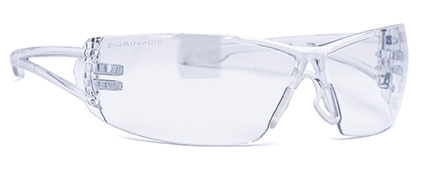
EXOR

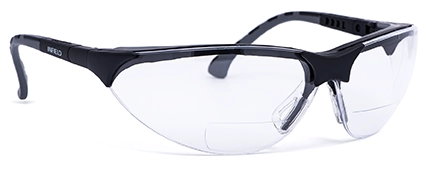
TERMINATOR

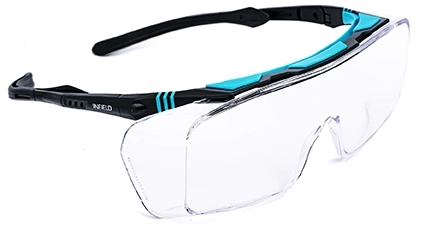
ONTOR

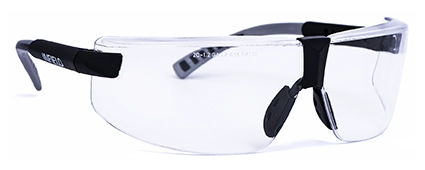
HUNTOR